Friday, June 15, 2012

FRANCE, LUXEMBOURG, GERMANY, DENMARK, NORWAY, SWEDEN - Part 3


FRANCE, LUXEMBOURG, GERMANY,

DENMARK, NORWAY, SWEDEN – Part 3

May 29, 2012

From Norway we crossed into Sweden into a land of endless forests and countless lakes. The snows higher up are still melting and the rivers are swollen to flood stage. Ran the air-con in the van for the first time with 28C outside. Our first night in the country included a losing battle with a gazillion mosquitos, the result of a country full of lakes and rivers. As we’ve said before, the red-wine colour in Norway and Sweden is extremely popular made such by a red by-product from the world’s longest lasting, at 300 years, copper mine and one of the biggest for its time.

As we drove toward Stockholm through more and more towns we also began to see more and more immaculately restored cars from the 50s to the 70s. Certainly brought back memories, all good.

Thanks to our Tom-Tom GPS unit we arrived safe and sound, though held up by a drawbridge letting expensive sailboats through, into one of the oddest campsites we’ve ever stayed in. Located in the middle of the city of Stockholm. Good. Under a noisy bridge and airplane landing path. Not so good. “Sites” were dirty dusty dirt with the facilities inside the remnants of construction materials. Bad. But we stayed two nights so we could spend a full day in the city. Stockholm is on the southeastern coast of the country very far from the rest of Sweden and as a result seems to go overboard to be the best at everything. It is built on fourteen islands with walkways and bike paths everywhere. If you hear a chinsy bell, it’s not your imagination…it’s time to get out of the way of an overzealous bikist (a wanna-be cyclist going too fast on a too-heavy-to-stop bicycle). We walked the three kilometers from the “campground” to the old part of the town. Neat old buildings stuffed full of too many restaurants, too many junk shops and too many tourists of yet another cruise ship recognizable by the same “follow me” banners the guides use to keep their flock from getting lost.

Canada likes its moose…but not like Sweden. It appears everywhere, sometimes in odd positions. What ever happened to the famous Vikings?

Maybe this is the answer. This odd couple can be seen in broad daylight. Note the cheeky hand placement.

The mating result was what is commonly known here as the reason for the disappearance of the Viking race, the last such person was this blue-helmeted not-so-blond goddess.

In 1628 these same people wanted to continue their famous sea-faring heritage by building a monster wooden ship measuring 69 meters long and 49 meters tall. It was the pride of the Swedish crown. Within minutes of its launching, the top-heavy vessel capsized sending it and its 100 man crew straight to the bottom. Not to be outdone by ancient stupidity, in 1961 the vessel, in 14000 pieces, was raised and reassembled inside its very own ready-made museum. The one shown here isn’t it but merely a suggestion of what maybe, just maybe, should have been attempted.

From Stockholm, the driving was tedious and boring as was, frankly, the country-side. Endless trees, very few buildings, and no moose in sight regardless of the “Moose Crossing” signs. Maybe they too ran off with the Viking goddess.

So…our general view of Sweden? Very nice people but the scenery is bland especially after having first been through Norway. And Stockholm doesn’t seem to fit into the rest of the country…too many cultural differences. Having said that this poor little sad, and dry, mermaid was sorry to see us leave.

From Sweden we crossed into Denmark again over the long, beautiful and very expensive ($120!!!) bridge under threatening skies soon to turn to full-on rain with heavy traffic. Fun. Through Copenhagen to a campground on the edge of an 1886 fort complete with the old cannons and bunkers on the edge of the sea. Tuborg, the Danish beer company, offered us a large beer to compensate. We expect to have it finished in about 12 years!

The next day we took the local bus 14 into the center of Copenhagen to visit the old town and the canal district. Copenhagen is a delight being a mix of Amsterdam and Paris. Old brick buildings, incredible churches some looking like they rose right out of Babylon.

The city is full of bike paths which are full of people roaring by on single-speed oldies going from where they were to where they are going. As a pedestrian it is in your best interest to stay on the sidewalk or get creamed. The beautiful lady cyclists in short skirts add to the flair of it all. Some of the bikes are meant to carry things in front of then…everything from stuff and things to kids. Even some taxis have bike racks for passengers who have a bike but have far to go.

And of course there is the royal castle complete with the family tree of the royals, the useless battles fought over colonies, two eighteen year old guards, and all things paid for by the non-royals. Kinda cute but after a number of these royal affairs they all feel and smell the same. Lose a historical battle and become a taxpayer – Win a historical battle and ya got it made. And let us not forget the crown jewels.

Copenhagen is a very nice place where there is lots to see. It has a great feel with very nice people. And where did we eat? In an Irish pub of course!!

Tuesday, June 12, 2012


FRANCE, LUXEMBOURG, GERMANY,

DENMARK, NORWAY, SWEDEN – Part 2

May 23, 2012


May 18…and SUNSHINE!!! About time!! Continuing along the coast which seems more and more like B.C. and Alaska. Seeing lots of wood split for household burning in standard mesh bags about one meter cube. They need it here with the short cold winters and the size of the houses which are large. Most have two or three stories with lots of windows to take in the scenery. Some, but usually out buildings, have sod roofs. All the properties are clean and tidy; houses painted, lawns mowed and no junk lying around. And they love the colour red for the buildings; a darkish wine red…something we can relate to.

Same applies for their cars; doesn’t seem to be any beaters. The drivers don’t speed much (listening Canada??), never tailgate (listening France??), never honk (listening USA??), and are very courteous (listening all drivers??).

Lakes of all shapes and sizes are everywhere. Along the southwestern tip there is an incredibly beautiful large area of huge rounded boulders some the size of houses. The fjords are stunning! To get closer to them we chose to drive the secondary roads with few cars but which are really narrow and twisting. With their harsh Canadian-like winters here they can also be busted up and rough. No large towns; only small villages. Camped near Bursand with an amazing view of the ocean.

Back into light rain the next day through large rolling farmland fenced with the large rocks picked from the fields. More sheep. We stopped for a few groceries and the lady at the store told us they had had rain for the last eleven months! They were very sick of it. Really!?! And because of the cool temperatures and rain lately fresh snow was on the surrounding mountains.

Norway means fjords which means ferries…four for us today. While waiting for one we bought French fries in a small cafĂ©. A small handful cost the equivalent of $6 or about 25 cents per fry! With so many fjords there are lots of fish farms though none are big.


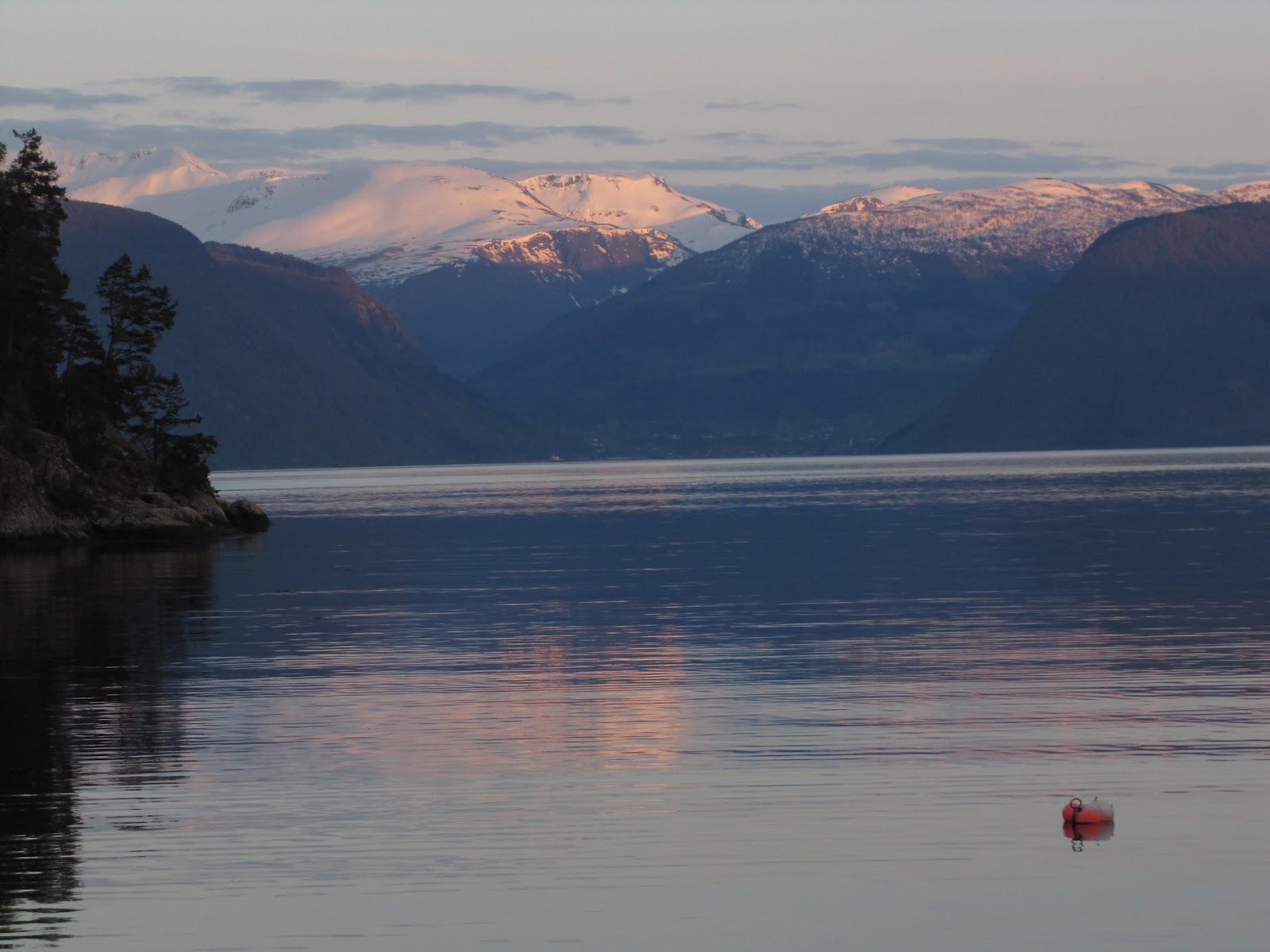
We had planned to stop in Bergen, Norway’s second largest city with 250,000 people, for a day but we were more interested in getting back into the countryside. We continued toward Balestrand, a very pretty town spread on the edge of the second-longest fjord. Looked to camp. Ah…closed. Asked a lady for directions and she promptly provided a map and information on the area…she worked for the tourism bureau and had some pamphlets with her. We continued another few kilometers and found the village of Dragsvik where we found a campground just opening for its first day of the season. And we camped five meters from the water with an endless view of the fjord one way and large snow covered mountains the other. The views were some of the most magical we have seen anywhere…so we stayed the next day, a 25C, sun-filled day. Turned out the owner had spent a month near Calgary and Banff while he was in the Norwegian army in joint training exercises with Canadian forces. Did he like Canada? Yes…but it was January and -40C! The rest of his tales included the burning down of a Canadian forces tent in the middle of the night. No…Norway never paid us back!!

While at this last campground we had a (few) drinks with a British couple also staying here. They have lived in Norway for one year hoping to stay permanently. Unfortunately they just cannot find substantial work and sadly have to go back to England. They absolutely love Norway and its people. Apparently housing is inexpensive here which is probably why we have rarely seen any small places. One thing they did mention though is the ability of anyone to get on the web with a simple piece of information such as a person’s name, address or telephone number and find out everything about their personal life including earnings. Privacy here is out the window!

One of the things everyone thinks about when they think Norway is Vikings. But oddly enough there is no talk about that part of their history here and rarely is a connection to the Vikings made in their buildings, names, tourism and so on. Not sure why this amazing piece of world history is put aside. Near Dragsvik though, there are two burial mounds said to contain parts of a Viking ship, the remains of a man and a woman, and other artifacts.

And of course as with all things, Norway has the biggest and longest…fjord. We crossed the two longest and deepest today, a day of three ferries. Both these cavernous bathtubs are over 1300 meters deep, the second-longest at 180 km long and the longest at 240 km long! Ocean-going cargo ships can be seen all the way to the ends to bring in goods. Driving around the perimeters of these fjords can be tiring and long and of course involves lots and lots and lots of tunnels. They are mostly poorly lit, which feels eerie, and can be long, which feels eerie. Our longest today was 7.5 km. One had three lanes the full length. This is far wider than most of the roads in this part of the world. Two narrow lanes are great but often it is a single lane, sometimes barely wide enough for our van, with small turnout places to let oncoming vehicles by. It does get very hairy at times.

May 22 and we continued on Route 13 on a stretch between Dragsvik and Forde into the high mountains and over a snow-bound pass. The scenery was as good as it gets. Twisting turning roads with hellish drop-offs and snow above our van…and that’s in mid-May! And of course at the end of the day was yet another ferry but this one with a crew member, a girl, who had studied in Vancouver for a year. She loved it and found BC’s west coast similar to Norway’s. Similar but not the same level. And she’s right. Though it isn’t often you’re come around the corner thinking you’re about to run into a good-sized cruise ship.

That day finished in Alesund, a beautifully situated fjord town of 42,000 people. The town burned totally in 1904 and was totally rebuilt with beautiful art-inspired buildings. It is also a stopover for the large cruise ships  and one was in during our visit. Nothing like walking the streets of a tourist sector with 5000 of your closest friends. And of course we had to try the Norwegian fish-and-chips. With all due respect to any other country claiming theirs is the greatest…move over…this was by far the BEST!!

Want to start your own cafĂ© or restaurant? Don’t rent a building…buy an old unused barge instead.

Want to be paid and get the benefits of a postal worker and sell ice cream on the side? Get something that both delivers mail and keeps the ice cream nice and cool.

The next day we headed east and sadly away from the fjords (pronounced “fee yords”)…or as we call them…FEE JJORDS. Temperatures were above 25C for the next few days with heavy humidity. Given that one lake was still half covered with ice!! Saw lots of old wooden barns and houses made of squared logs. These are old and may have been part of the old settlers. We wild-camped that night, our first time this trip, and it felt great to be back in nature with only the trees and the birds for company.

So we continued toward Sweden. And what did we think of Norway? Absolutely amazing! Magic! It is the most beautiful country we have ever seen…more beautiful than Canada and even New Zealand. The people are very helpful and friendly. It is expensive but come see the place…you will forever appreciate the mix of mountains, fjords and people.

Sunday, June 10, 2012

FRANCE, LUXEMBOURG, GERMANY, DENMARK, NORWAY, SWEDEN - Part 1


FRANCE, LUXEMBOURG, GERMANY,

DENMARK, NORWAY, SWEDEN – Part 1

May 17, 2012


The April weather continued into May with coolness, wetness, windiness…and with most people enduring seven weeks of this…bitchiness. And for the first day of our next jaunt, May 9, it followed. Light rain though turned to sunshine temperatures warm enough for shorts!! Okay then…no more complaining!

That day took us from Vendome, skirting Paris, through the un-vined part of the Champagne region and into the Lorraine department. Most of the day was through flat farmland called the Beauce, one of the largest agricultural regions in Europe. Verdun was our destination. This is where the largest battle of WWI took place. Ironically, some three kilometers from Verdun is a small town appropriately named Regret. The hills just outside Verdun were the hold-at-any-price front lines, and the price was steep. In 1916, two years into the war, the hills outside the town were bombed into oblivion. Nothing but mud, trenches which were part of a line from the North Sea to Switzerland, devastation, and corpses covered a grassless, treeless battleground. The fighting here lasted two years straight but the most fierce lasted seven months with non-stop shelling. The first two hours saw an estimated 1,000,000 bombs rip the hills apart….140 shells a second! By November 800,000 soldiers had died, an equal number from both sides. That’s 3810 a day!! There are huge French, German, and American cemeteries in the area with countless crosses marked “Unknown Soldier”.  Countless were never found. Some were found later. In one case, three years went by before someone noticed that bayonets were sticking out of the ground on one hillside; a search found that the rifles were still being held by dead French soldiers all buried alive by the mud blasted on top of them by the endless bombardment. The place is called “The Battlefield of Bayonets”. Nine towns were completely destroyed. Each is now marked at its original beginning and end with French road sides…as if they still existed…out of respect. Under a massive fortress in Verdun are the tunnels where up to 10,000 soldiers suffered, some waiting to go to the hills to be slaughtered, some waiting to die from the wounds they received where these frightened men were going. The cold, damp stench in the tunnels was nothing to what awaited them outside. We visited the battlefield of the Bayonets, the tunnels, and the hills above Verdun. It is an amazing shrine to humanity’s stupidity, cruelty, and hell-bent path to self-destruction. This is INTENDED to be one…long…paragraph. For every word in it, the full battle of Verdun lasted TWO DAYS!!! I had an uncle, my father’s brother who died in World War I, the so-called “war to end all wars”…well it didn’t! Come and see Verdun for yourself.

The next day we left Verdun and saw why this had been the major battle line. The hills outside the town suddenly became completely flat which of course would be more difficult to defend. The trenches in the ridge above Verdun made much more sense. The French department where Verdun is located is Loraine, part of France along with Alsace which went back and forth between French and German control for over a hundred years. Loraine is a depressed region now; it had lived on coal mines and steel mills now mostly gone. The towns show it; they are sad, buildings unkempt, and showing no flowers as are seen everywhere else in France.

Then it was through Luxemburg, a super-clean, super-crisp place with lots of wealth which shows in the cars, stores and buildings. We could move here. It’s a rolling hills region, very beautiful, and lots of vineyards. Very quickly it was into Germany without realizing it what with the lack of physical borders in today’s Europe. Beginning in Luxemburg we drove along the Mosel River in a fairly steep valley with vineyards everywhere including on the steepest of terrain. The Mosel River and its valley is one of the prettiest places we’ve seen anywhere. The river and connecting canals are used for pleasure boating as well as commercial transportation in barges. This area has some of the best cycling paths in Europe.

We continued northeast toward Kohl, Bremen and Hamburg. Canals in this region are also commonplace and well used.That afternoon and the next day saw driving conditions that varied from 25C, sunny and calm with light traffic to 7C, rain and 80 kph cold winds from the north with high-speed bumper-to-bumper free-for-alls. Wrestling a large, tall van in these latter conditions for a thousand kilometers was not exactly enjoyable. Our campsite in Germany was on the coast, battered by wild gusts…and totally warm inside our ever faithful White Night. This part of the country has mostly brick housing and lots of alternative energy sources with wind turbines and solar power.


On to Denmark where wind power is even more prevalent; not surprising in the flat land wind constant winds from the North Sea. The country side is rolling hills with large dairy and crop farming while the west coast is one long sand dune which protects the coast. At the end we had intended to take a small ferry but found absolutely no info on cost or times. We couldn’t even get the attention of the ferry crew when it did come in…so we left and went the long way around. Denmark is a camper’s heaven with great campground everywhere. The weather continues to suck with 10C, high winds and rain.

The next day was a quick hour drive to the west coast at the ferry port of Frederikshavn. We wanted to catch the 10 am boat but it couldn’t come in from Sweden due to high winds. We went into town with another French couple, Bernard and Chantal, we met on the docks. Found a coffee shop with a waitress who had an odd accent. She was from San Francisco and had lived there for 18 years. How did she like Denmark? Amazing, she exulted, especially with the socialized medicine!! The 2 pm crossing to Goteborg, Sweden was fairly smooth but we arrived at the height of traffic hour. Rain and crazy city traffic made for serious forehead creases. Drove to Grebbestad to camp. The town is small, on the coast and as pretty as they come. We stayed one extra to visit and rest up a bit from all the driving so far. It’s a place we could live since they already have life-size likenesses of the two of us.

May 16 we drove from Sweden’s west coast, up above Oslo, Norway and down to the Norwegian coast. The inland countryside is very much like British Columbia, Canada and made us homesick. Just inside Norway, we pulled over to let a car go by but as soon as we did it cut is off and stopped abruptly. Two young guys jumped out looking like well-shaved Rambos with killer gear hanging off them everywhere. What the…?!?! They announced they were from Customs Norway. Phew! A quick chat and they realized we weren’t smuggling people, drugs or fish. Although we didn’t confess that we had converted most of our van’s gas tank into a wine cellar!

As in Sweden, much of the homes and barns in Norway are painted the same colour…a wine red, usually with white trim. Houses are wooden since these countries have an ample supply of lumber. In Canada you see wooden houses with the clapboards laid horizontally while here they are put on vertically. A nice look especially on the numerous out-buildings which are on stone stilts. Lots of medium sized farms.
Finding campgrounds in this part of the world is and isn’t easy. They are plentiful but poorly marked. The one we finally found near Langesund, about 150 km southwest of Oslo, was one of the prettiest and most calm places we have ever seen anywhere. The mini-me fjord fifty meters behind us was stunning with rock formations from both platonic uplifts to smooth-as-glass rock polished by the last glacial age. The campground didn’t accept Euros or foreign credit cards so we had to go into town the next day to find an ATM to get local currency. Being May 17, Norway’s national holiday, parades were in the streets and the traditional costumes were out of the closet.

Price of fuel? Diesel was almost 14 Kronas or 2 Euros or about $2.75 Canadian!!! A liter!!!!!!!!!!!!!!!!! Twice the price of Canada and 50% higher than France.


Sunday, May 6, 2012

FRANCE - MAY 6, 2012


The weather in March was amazing with sunny skies and temperatures in the high teens, low twenties…perfect for cycling. Dawn tried to bike but her shoulder continued to cause her pain. So her doctor here decided to have X-rays and ultrasound done. And now it’s confirmed that when she fell, twice, in Paris riding a Segway, she broke, twice, her left collarbone. All she can do now is to continue to let it heal.

You may recall that in the blog of March 1 we described being “held up” by an uncooperative barrier at a toll booth on a road in Portugal. The end result was that they would send us a cheque for 20 Euros. Got a very official letter March 28 from Portugal informing us that… “After a thorough analysis of the situation, it was possible to confirm…”. Thorough?!?  Analysis?!?  For 17.85 Euros?!? (Did we not mention it was not going to be 20 Euros as originally stated?) And governments around the world wonder why their administration costs are killing them. Well wonder not! So now they want our banking information to transfer said 17.85 Euros. This is where humour comes in…Don’t leave home without it!! By the way…the letter was sent ‘Air Mail Priority’. As we said the last time...stay tuned.

It wasn’t April Fool’s Day…but close. April 2nd was a vehicle day. First, as we were driving behind a large farm tractor with a wide apparatus on the back, a car coming in the other direction had its driver’s rear-view mirror smashed off with a terrific bang as the farming equipment swayed back and forth on soft tires. Then, our little blue car with licence plate numbers ending in “EH” (totally appropriate for a Canadian) had a fit with the engine reving beyond control, losing water and emitting enough blue smoke to hid us from astonished onlookers.

The couple who we travelled through the Balkans with purchased a rental house and needed help for work to do both inside and out. A number of their friends “volunteered” (at gun-point) and got the job done. As a thanks Daniel and Jojo threw a dinner at their house for their helpers, us included, which lasted four hours. This constituted one hour of eating and three hours of drinking…the usual, acceptable and appropriate ratio in France.

The last half of March was June-like weather with 20C+ temperatures with cloudless skies. April was different with 12C temps and showers. Cycling went from lots to barely any. And even then, in between showers or hail storms.

The coolness of the April showers was cut through by an amazing dinner at friends, he the son of our landlord, she a Thai girl with cooking skills “par excellence”. Never had we eaten so well “a la” Thai. I told her that should she get sick of her husband, she should let me know. That’s when he stopped pouring me any more wine!

But the best entertainment in France in April was the presidential elections. And just like all the other countries around the world going through elections since the beginning of the economic crisis, totally dysfunctional. The French have a particular dislike though of …well…practically everything when they personally aren’t doing well. Blaming the other guy is just what you do here after you’ve had your seventh glass of wine before noon.

--------------------------------------------------------------------------------------------------------------------------

April 30, 2012 we found out an amazing friend of ours passed away that morning in Vernon, BC. John Hunter was a class act, a good friend and someone we will terribly miss. A Scot, an Oatmeal Savage he called himself, with a sense of humour and memory for jokes that made his home-made wine go down smooth as silk. He was the funniest man we’ve ever known with a heart as big as all outdoors. John made the sky brighter and the sun warmer. He took us under his wing when we needed it. He and his wife were simple, honest people who loved to party and laugh…and were just plain great fun to be with. If we needed a spirit pick-me-up, we didn’t take a pill…we spent time with John and Margaret. We feel deep gratitude for their presence in our life and for the enrichment they both brought us. We miss them both. But we will forever remember laughing at some of the shenanigans we got ourselves into together. We will continue to laugh with them forever.

--------------------------------------------------------------------------------------------------------------------------

Spring in France just may be the most beautiful season especially in this part of the country with new crops coming forth. One of the brightest is the canola crop…one of the prettiest and brightest yellow you can imagine especially beside the green of the young grain shoots.

And now for something totally different (sort of). For those of you who have read this blog from the beginning and have read the one from our year in France/Europe in 2005/2006, you will know that one of the characteristics of France is that everything seems to have a title, an order, an organization to distinguish it from something else. As a result someone is the president, director, chairperson of said title, order, or organization. Today the national news interviewed someone of great importance to do with…well…actually…we just can’t remember. Especially after we saw the person’s title… “Director of the World’s Navel”. For those of us who think of ourselves as important, this shows that given the right circumstances, we can always find someone even more elevated. Sorry…no picture available or even permitted for this one. Another glass of wine please!

An illness in our family in France means we’ll be changing our plans. We’ll be leaving earlier up to Denmark, Norway and Sweden, and coming back much sooner, around June 13. Hungary, Czech and Slovakia will have to wait. Poland is still the plan as we need to be near Warsaw July 12-14.

Sunday, March 11, 2012

SPAIN, FRANCE - March 11, 2012

Spain, France - March 11, 2012

We lobed into a campground near Amarante on northeast coast of Spain. One of the unique things
to notice here are the breadbox-like (Dawn’s description), coffin-like (my description) elevated “things” which originally were used to store corn and grain to dry. Stunningly beautiful area along a rugged coast but…the campground was without electricity. So the next day we headed out over hills peppered with wind turbines and even more stunning scenery.
We arrived at a campground outside Luarco with a feisty kitten which was ready to come home with us. The campsite was about 100 meters straight up from the ocean with pounding seas. With such scenery and weather being so magical we stayed two days. Each night the lighthouse about two kilometers away worked tirelessly to warn seafarers of the coastal dangers. It didn’t affect our wine drinking though. Swiss folks who camped next to us had stayed two weeks in Los Escullos (the campground in Southern Spain we had stayed in for two months). There is lots of farming in this region of Spain, mainly milk cows which offer a snootful of odours.

We headed around and past Santiago de Compostella, a world famous pilgrimage route to where St. James the Apostle is supposedly buried. Lots of signs on the roads marking the route for the cyclists and the walkers.

And here, when they set up a cemetery, they do not mess about. There are a few of these ornate jobees in a small area. Though over the top and extremely ornate, they are impressive.

The northwestern part of Spain is very hilly and green…meaning lots of rain. A beautiful rugged coastline which is basically the western continuation of the Pyrenees. There is a national park here called Los Picos de Europa or The Peaks of Europe. High mountains with snow this time of year and some of the most beautiful mountain scenery we’ve seen anywhere. We continued on around Santandar on the coast and through Bilbao, a crazy city.

This is Basque country, a region mostly in Spain but jutting also into France, long known for wanting to form its own country. The separatist group’s terrorist activists have stopped but the feelings have not. Most signs are in Spanish and Basque, a language which has never been traced to its source. With the terrain so rugged and valleys so narrow most towns have grown up rather than out. What may be a town of modest population has endless large and tall apartment blocks for housing and business. We camped in Zarautz on the coast. The campsites were above the sea and looking down on the town with its wide sandy beach making for an amazing view especially at night.

The next day…France…land of cheese, baguettes, and constant labour strikes. Through St. Jean de Luz and the Biaritz/Bayonne area with its crazy traffic even during the off season. In 2006 we spent a week here. Up through the southwest with the large tree farms of France before hitting what most consider to be the most famous wine region in the world…the Bordeaux region. Endless vineyards as far as the palate can taste.

One particular wine, Chateau Margaux, goes for 50 Euros to 1000 Euros ($75 to $1500) a bottle!!! A BOTTLE!! A few years ago a (very good) friend shared one of his with us. It really was amazing! Selfish S.O.B. didn’t want to crack another though! We bought many of you a few of these so carefully and patiently watch your mail-boxes for the arrivals. We camped here just to catch the aromas and sniff a few vines.
Under gorgeous sunshine we drove to Isle de Re, an island (though linked by a bridge), we had wanted to see for years. Long, pretty, narrow, it is home to lighthouses, a local wine, sandbars, high winds, twisted trees, and the funkiest long-haired donkeys you have ever seen! We had lunch in St. Martin de Re, the largest of the ports and known for “the place to be seen”…nobody saw us.

After two days we left the island toward Piriac, about three hours north on the coast of Brittany, and one of Dawn’s most favourite places on the planet.
The area is known for its tough characters, a difficult Celtic language, thatched roofed houses, and a preference for apple cider rather than wine (just to prove they really aren’t French). Over the last twenty years we’ve spent lots of time here as one of my uncles kept a base in Piriac for his boat and seafaring activities. Piriac is one of the prettiest old fishing villages you'll see anywhere.
We’ve been here during the wild storms of February when nothing was open and no tourists were to be seen outside Paris and during the crazy tourist-packed summer months of blue skies. My uncle doesn’t stay here anymore but we came through to check up on old friends. One, Mr. Garnier (everyone calls him Mr. out of respect) is VERY old…he turned 101 years old last month and we wanted to congratulate him and just say hi. The others, Rene and Jose, were fishing friends of my uncle’s whom we got to know well (over a drink) and whose company we always enjoyed (over a drink).

From Piriac it was off to the Loire Valley, famous for chateaus and, more importantly, delectable wines such as Saumur, Chinon and white Sancerre. We had seen Chinon and Sancerre, as well as the inside of their bottles before, so this time we decided on Saumur on the south side of the Loire valley just west of Tours. A beautiful town with endless 17th and 18th century houses and an overpowering chateau for those who were from the very rich and famous class, notably the French royalty otherwise based in Paris.

The next day, March 9, we arrived back in Areines and the little apartment we use as a “home” base. Unloaded the van, opened a fresh bottle of wine…and started talking of the next leg of this incredible journey…Scandinavia.

The weather turned cooler and a more humid but very tolerable…still better than being in the office.

Thursday, March 1, 2012

PORTUGAL - Part 2- Mar. 1, 2012


>


PORTUGAL – Part 2
March 1, 2012


Portugal also is home to some of the biggest birds you’ll see anywhere. These black and white storks love to make a nest the size of a small car it seems atop the highest man-made object around. No natural stuff for them other than the twigs used for the nests themselves. Preferences include chimney tops (helps keep the house warm by not letting warm smoke escape) and metal power towers. The towers usually have up to four levels sometimes with a nest on each level making the thing look like a place which might be called Bird Do-Do View Condo Estates (electricity included).

This country is following Spain as a large olive producer though not with the same height of quality reputation. Wines and of course port further north are well known.

We joined two camping associations. One, Orbitur, is for campgrounds only in Portugal while the other, ACSI, is internationally recognized and covers most of Europe with excellent information and discounts. The ACSI can be joined in any country but in our case we got it via our Dutch friends who are still travelling with us. Though the books came from Holland and are in Dutch, we can figure them out with a little help from Willemien.

Right now we’re enjoying walking the beach here while we stay put for a few days waiting for our ACSI books and parts for Frans’ broken (again) bike rack.

Prices of food and gasoline here seem higher than Spain. We are in the Algarve though which is a big tourist area so we’ll have to see as we go further north.

One of the things to watch out for in campgrounds with electricity is the number of amps in the system. They can be a reasonable level (say 15 amps) of low (6 amps). This means you need to watch how many electrical appliances are running at the same time. You run too many totalling over the systems power level and it blows leaving you to find the circuit breaker (good luck) or go to the campground office to ask them to send someone good luck) or cook your meal with a magnifying glass at night (good luck again!). We’ve had to do all three and so now we’re much more aware of how much juice we’re pulling.

And on Feb. 15, 2012 we celebrated Willimien’s birthday. We took her and Frans out for lunch along the sandy beach of the Atlantic. Food sucked but company was great.

The next day we headed north and stopped just south of Lisbon in Sebutal. Getting here we took the autoroute, Frans’ preferred travelling method though not ours. It would be our last. The approximate 225 km cost us 33 euros (about $45)!! We were the only two campers in the campground outside the town though it was almost completely filled with permanent camper units, all empty save one or two, quite common in Europe. Following Sebutal, Portugal’s third largest port we continued north, though not on the expensive motorways, toward Nazare, a town of 16000 people and renown for its narrow streets and women wearing multi (some say seven…but I wasn’t permitted to count them) layers of slips making for a very fluffy Mary Poppins look.


While we were there Carnaval took place over four days. It is a large religious holiday and festival involving bands, noise, costumes, food stands and a look and feel somewhere between Halloween and New Year’s Day. Most of this in Nazare takes place on a street along one of the most beautiful beaches in Europe making the setting perfect.


Back into road cycling with continued great sunny warm weather and a quiet road near the beaches which the locals tells us see waves up to 30 meters (100 ft) high!!! Apparently last night some big ones came in which explained the thunderous crashing noises we were hearing in the night. It might also have been the gods angry over my method of bringing wine to camp on my mountain bike! (Thought I had made up for it with bread in the rear bottle holder…guess not.)

Portugal is known for an air-dried fish (smells like hell and tastes worse!). Lots are produced in Nazare. The heads are left on to give them an artsy look (though not flavour).

As in most places it is common courtesy to ask permission to take someone’s picture. In some countries, Morocco for example, it is rarely given. In some countries, such as some places in Africa, tourists have been killed for taking a photo of someone without their permission…they believe their soul has been taken. Fortunately here in Portugal people are more open.

Then…ah, then…on to Porto…one of the places I’ve wanted to get to since that first sip of port wine. A simple drive to a campground on the west side of the country to where the waves pound the sandy wide beaches with a vengeance. During high tide, they sound like an angry train coming through.

The next day we took a local bus for the 45 minute ride into Porto. (The bus ride was an adventure all its own. The full length machine was driven at breakneck speed by a grumpy driver down, around and up what most people would think of as wide lanes. At times we had to come to an almost complete stop to ensure the bus’ side motion didn’t scrape the stone walls. At one point and with no apparent interest about traffic behind him, the driver stopped to let out a woman passenger who went into a shoe repair store, dropped off her shoes to be fixed, and got back on the bus!)

Porto is a subtle and beautiful 900 year old city with a magical old section along the famous Douro River. The old town has many buildings with the traditional tiles, some telling a story. Many of the roofs are orange clay tiles and give the place a joyful look. While visiting this area we were approached by a man offering his tour guiding services. He asked where I was from. When he realized it was Canada, he said he had relatives in Prince George, BC. He had me convinced when he said he also had relatives in Armstrong, BC just down the road from where my mother lives. I mentioned Dawn and I had lived in a town just south of Armstrong to which he quickly replied, “Oh, Vernon. Yes, I’ve been there.” It really is a small world.

The river itself is deep and wide and has a similar appearance to the Grand Canal in Venice, Italy. The river has cut a deep valley so that the traffic bridges are incredibly high and long. The old town is very historical and made famous for its production and export of port wine around the world but originally to England. The Portuguese wine was fortified with spirits for the voyage north by schooner. The fortified wine, now called port, helped to establish a number of “houses”, or port businesses, owned at one time solely by the British. The English names have continued but the ownership has changed. Large areas of warehouses where the port ages sit on the south side of the Douro River in the middle of the city. A number of the larger port brands are located here and have tours and sampling. We sampled…we bought!

At the end of February we left Porto along the grand Duoro River. Soon we followed our Dutch friends unto a new highway not yet on our GPS. No choice but to continue. Part way on we were forced to get a ticket which we would later use to pay the toll for the distance we had travelled on the road. Some twenty kilometers later we wanted to exit which meant going through a pay booth. Process = put ticket in the machine + insert money + receive change = exit. Everything went well…oh, except the part where we get our change and are released from highway prison. Push every button…no good. Eventually the machine started to talk…it was a live person! Speaking to us in English! He soon announced the problem…the machine was broken. No kidding!?! We would need to stay in the van outside of the vision of the motion detectors and give him our mailing address. What?? Why? So they could send us a cheque to replace the money we had inserted into the now broken machine. Can’t you have one of the other machines give us our money back? Nope! Not in the procedures. Eventually a highway representative came. Good…he would give us our money and we would be on our way. Nope! He was there to read our mailing address off an official document to the machine’s voice (something we could have done of course). But could he not simply give us our cash back? Nope? Not in the procedures. I asked if they could send the Portuguese army to release us. Nope! Not in the procedures. We all laughed at that point. Finally released we went on our delayed way anxiously awaiting our refund by cheque which no doubt will not be accepted by a French bank. Probably not in the procedures. Stay tuned.

February 29, leap year’s extra day, and we left Portugal for northwestern Spain. It was also the day when we left our Dutch friends “Smile and the Gang”. We headed north while they would head east not having to get to Holland for another two months. We spent the better part of six weeks together in Spain, Morocco and Portugal all the while having a great time and making each other laugh. We plan to link up with them again.